How It Works
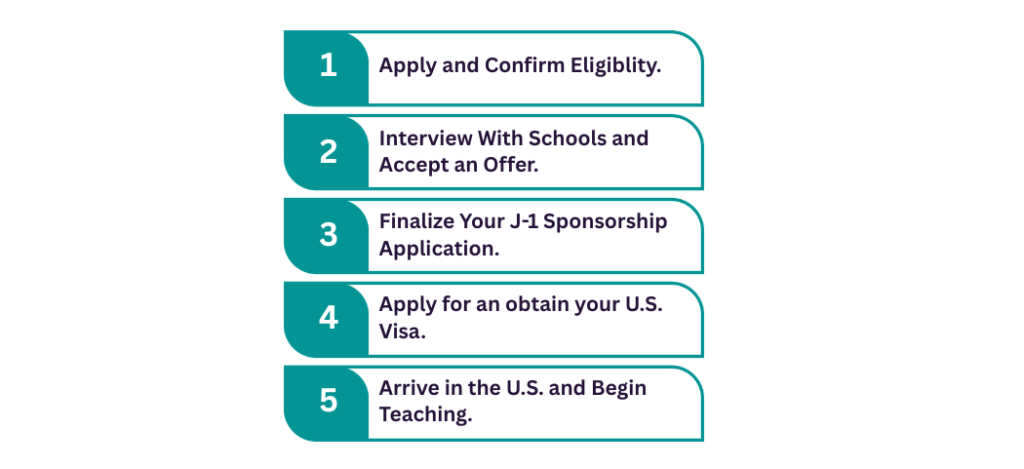
The J-1 Teacher Program, guided by 22 CFR 62.24, aims to promote the interchange of U.S. and foreign teachers and enhance mutual understanding between the people of the United States and other countries. Exchange teachers sharpen their professional skills and participate in cross-cultural activities in schools and communities, and they return home after the exchange to share their experiences and increased knowledge of the United States and the U.S. educational system. Such exchanges enable foreign teachers to understand better U.S. culture, society and teaching practices at the primary and secondary levels, and enhance U.S. students’ knowledge of foreign cultures, customs and teaching approaches.
Whether you’re ready to begin a rewarding journey as an exchange teacher, aiming to enhance your school community with talented international educators, or interested in building meaningful partnerships through cultural exchange, this program offers tailored pathways to support your goals. Explore diverse opportunities below and take the first step towards an exciting adventure.
Program sponsor brings a wealth of knowledge and expertise to every aspect of the program. Their extensive history ensures a well-established and reliable framework for successful participant experiences.

Expect prompt turnarounds and straightforward application processing.

Program sponsor provides candidates with program placement opportunities that are posted on the website, updated frequently.

Program sponsor provides participants with a comprehensive Pre-Departure Orientation to help ensure a successful program experience.

Program sponsor obtains Sickness & Accident Insurance coverage for each program participant in accordance with U.S. government requirements

Program sponsor provides comprehensive guidance and resources throughout a participant’s program.

Program sponsor provides a toll-free, 24-hour program assistance hotline.
1-Year Placements
Ideal for applicants looking to engage in short-term cultural exchange. This option allows you to explore the benefits of hosting an international educator with a one-year commitment.
2-3 Year Placements
Designed for applicants aiming to foster deeper connections and long-term contributions from international teachers. These placements give educators ample time to integrate into your school community and make a lasting impact.
Extensions Beyond 3 Years
For schools and teachers seeking to continue their collaboration, the program offers the possibility of extending placements beyond the initial term, up to a maximum of 5 years, pending approval.
For program applicants who do not have a confirmed teaching position in the U.S. and are seeking placement assistance from a program sponsor.
For program applicants who have a teaching position in the U.S. and are seeking a program sponsor.
To qualify for the J-1 Teacher Program, applicants must meet the following criteria:
Exchange teachers are required to complete and submit an annual cultural activity report as part of the J-1 Teacher Program. This report must detail the cross-cultural activities conducted during each academic year. The purpose of this requirement is to ensure that exchange teachers actively contribute to cultural exchange by sharing aspects of their home country’s culture, traditions, and educational practices with their U.S. students and communities. Additionally, these activities should foster dialogue between U.S. students and students in the teacher’s home country, enhancing mutual understanding and global awareness. This annual reporting helps the program sponsor and the U.S. Department of State monitor and assess the effectiveness of the cultural exchange components of the program.
You will work as a full-time teacher of record in a U.S. K–12 school, responsible for lesson planning, instruction, grading, and participating in school activities—just like a local U.S. teacher. In addition, you are required to complete and submit an annual cultural activity report.
Applicants must:
Sometimes yes—if your degree is in the subject you teach and your experience is strong. However, some U.S. states may still require additional certification.
Not always. The program sponsor assesses English through interviews, but some placements or states may still require a formal test to apply for a teacher license.
You can list preferences, but placement depends on where schools are hiring. Flexibility significantly increases your chances of securing a position.
No — you typically do not need a U.S. teaching license before applying to the program. However:
Program sponsor and/or host school will guide you through:
Important: Licensing requirements vary by state, and in some cases, you may need to complete additional coursework or testing after arrival.
You will have good chances to secure a teaching position if you:
Typically, 3–6 months, but it can be faster if documents and interviews move quickly.
Yes. You’ll usually have 1–3 interviews with school administrators before receiving an offer.
You’ll earn the same salary as a U.S. teacher with similar qualifications in that district. This varies widely by state (roughly $40K–$70K+).
Yes, but this depends on the location. Cities with higher salaries often also have higher living costs. Budgeting is important. Program sponsor provides a budget sheet to help you estimate your expenses.
Yes, there are fees associated with the program. Always review the full breakdown of fees before committing.
Common upfront costs include:
Yes, but you’ll receive guidance and resources on how to locate and secure suitable housing. Some schools may be able to help with this process.
Yes, on J-2 visas. A separate application and fee are required for J-2 dependents—defined as the spouse or unmarried child under 21 of a J-1 exchange visitor.
Yes, but they must apply for work authorization after arrival, which can take a few months.
Lorem ipsum dolor sit amet, consectetuer adipiscing elit, sed diam nonummy nibh euismod tincidunt ut laoreet dolore magna aliquam erat volutpat.
You’ll be supported, but expectations are high. Schools expect you to perform like any teacher. Your program sponsor and your host school will provide the support you need to succeed in your teaching assignment.
Only in limited cases and with your program sponsor’s approval. This is not easy, so choosing the right placement matters.
Common challenges include:
No. The J-1 visa is temporary. All exchange teachers are expected to depart the U.S. at the end of their teaching assignment.
Submit your inquiry now, and our dedicated team will guide you through the process every step of the way.