How It Works
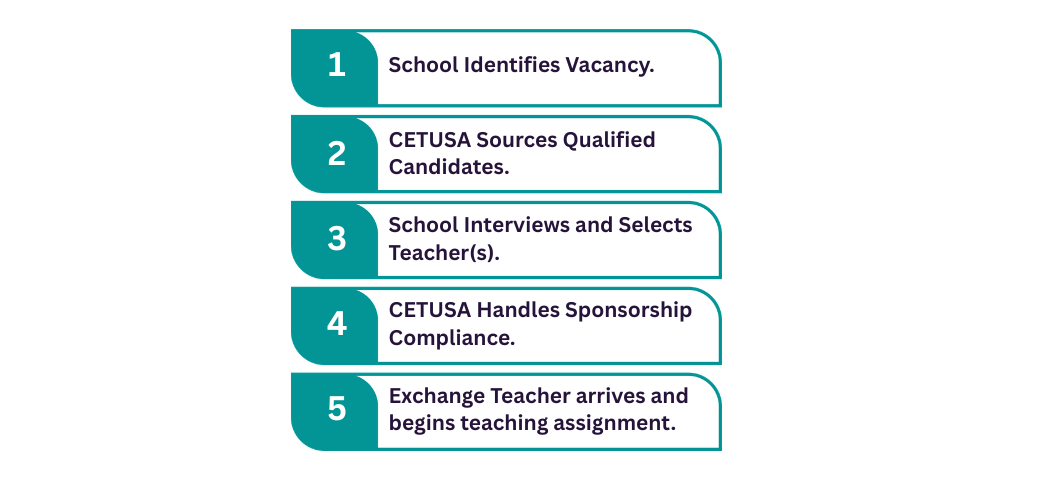
The J-1 Teacher Program, guided by 22 CFR 62.24, aims to promote the interchange of U.S. and foreign teachers and enhance mutual understanding between the people of the United States and other countries. Exchange teachers sharpen their professional skills and participate in cross-cultural activities in schools and communities, and they return home after the exchange to share their experiences and increased knowledge of the United States and the U.S. educational system. Such exchanges enable foreign teachers to understand better U.S. culture, society and teaching practices at the primary and secondary levels, and enhance U.S. students’ knowledge of foreign cultures, customs and teaching approaches.
Partner with a U.S. Department of State designated J-1 Teacher Program sponsor to bring qualified international educators into your school while addressing staffing needs and enriching your learning environment.
Discover the numerous advantages of hosting a J-1 Exchange Teacher at your school.
1-Year Placements
Ideal for applicants looking to engage in short-term cultural exchange. This option allows you to explore the benefits of hosting an international educator with a one-year commitment.
2-3 Year Placements
Designed for applicants aiming to foster deeper connections and long-term contributions from international teachers. These placements give educators ample time to integrate into your school community and make a lasting impact.
Extensions Beyond 3 Years
For schools and teachers seeking to continue their collaboration, the program offers the possibility of extending placements beyond the initial term, up to a maximum of 5 years, pending approval.
Host school must be in one of the following states:
J-1 Teacher Program positions are typically available in the following subject areas:
J-1 Exchange Teachers must receive benefits, and salary increases comparable to those provided to American teachers with similar qualifications and experience. Host schools are required to extend to participants the same access to health insurance, professional development opportunities, and paid leave granted to their local teaching staff. In addition, participants should be eligible for any salary adjustments or pay increases that occur during their period of employment, ensuring compensation remains fair and reflective of their performance and contributions. These provisions are intended to promote equitable treatment, adequate support, and full engagement in both teaching responsibilities and cultural exchange objectives.
Because participants are considered temporary employees, they must be covered under the host school’s workers’ compensation insurance in the event of a work-related injury or illness. If a school is not legally required to maintain workers’ compensation coverage, it must provide documentation of exemption along with proof of alternative insurance coverage.
Schools hire exchange teachers to bring international expertise, find a uniquely qualified teacher, promote cultural exchange in the classroom, and bring a global perspective to its students and staff.
Yes. They are hired as full-time teachers, not teaching assistants.
Exchange teachers are typically strong in subject knowledge, experienced in structured teaching, and less familiar with U.S. classroom culture (initially).
The most common subjects are STEM, Primary Education, Special Education and World Languages.
Initially, up to 3 years, with the option to extend to a total of 5 years.
A designated sponsor organization manages visa processing and ensures compliance with federal regulations.
Schools must:
The school must pay the exchange teacher’s salary (same as a U.S. teacher). The school may choose to pay exchange teacher program fees.
Typically, 2–4 months, depending on timing and candidate availability.
If performance issues arise, the host school should address them directly and discuss them openly with the exchange teacher; for persistent or serious problems, program sponsor can assist with:
Yes, many schools request exchange teachers based on:
Yes. Since the requirements vary by state, exchange teachers often work toward certification after arrival, with the assistance and guidance from the host school.
More than local hires—especially in:
No, but helping exchange teachers settle in (guidance, contacts) improves retention and overall program experience.
Host schools should help the exchange teacher participate in the following:
Not through the J-1 program. The exchange teachers are expected to depart the U.S. at the end of their teaching assignment, per J-1 visa regulations and program objectives.
Successful Host Schools:
Submit your inquiry now, and our dedicated team will guide you through the process every step of the way.